
David Puell on the Bitcoin Bottom, and Quantum Risk | Unbiased Podcast
CryptoQuant.com
TL;DR
David Puell of ARK Invest thinks Bitcoin may have put in an unusual cycle bottom. The drawdown was about 50%, against 70–90% in past cycles, and price never fully reverted to realized price. Capitulation signals did fire. Puell argues that on-chain metrics still work, but only once you correct for ETFs, custody changes and investors front-running well-known levels. He thinks quantum risk is real but mostly priced in for now.
Key takeaways
Atypical bottom: supply in loss overtook supply in profit, a classic bottom marker. But price never fully reverted to the market's cost basis, so a retest of realized price stays a downside risk.
What would confirm a new trend: higher highs and higher lows, sustained transaction volume, and SOPR holding above 1 without new lows.
Metrics need recalibrating, not discarding:
Account for observer effects, since institutions front-run well-known levels.
Account for compressing volatility.
Account for custody changes that distort holder metrics.
Whale metrics are noisy: Puell prefers holding time weighted by volume. Julio Moreno filters out exchanges and tracks growth in holdings rather than balance levels.
Quantum: Puell calls it the most important topic for Bitcoin over the next 5–10 years. He thinks the current threat is largely priced in, and that the fight over dormant coins, including Satoshi's, will be more contentious than the choice of signature scheme.
Demand: the only hard proof of demand is coins that stay put. Julio's apparent demand metric showed demand contracting even when Bitcoin traded above $100K.
An atypical bottom
David Puell has spent nine years in the industry, about four of them at ARK Invest, where his current focus is market analysis and the quantum threat to Bitcoin. He joined Unbiased hosts Ben Sizelove and Julio Moreno during a week when a sharp rally had just interrupted the bear market.
He read the move as a short squeeze: heavy liquidations, and the first real upward momentum in years. Puell compared its strength to the first big move after FTX, the one that started the last bull market. But he stressed that this bottom doesn't look like the earlier ones.
Shallower drawdown: about 50%, against the 70–90% range of past cycle bottoms.
No full mean reversion: price didn't fall back to realized price, investor price or any other cost-basis level that has marked previous floors.
Capitulation did happen: supply in loss overtook supply in profit as a share of total supply. "You could say we had a very robust capitulation, which is what you want to see in seller exhaustion."
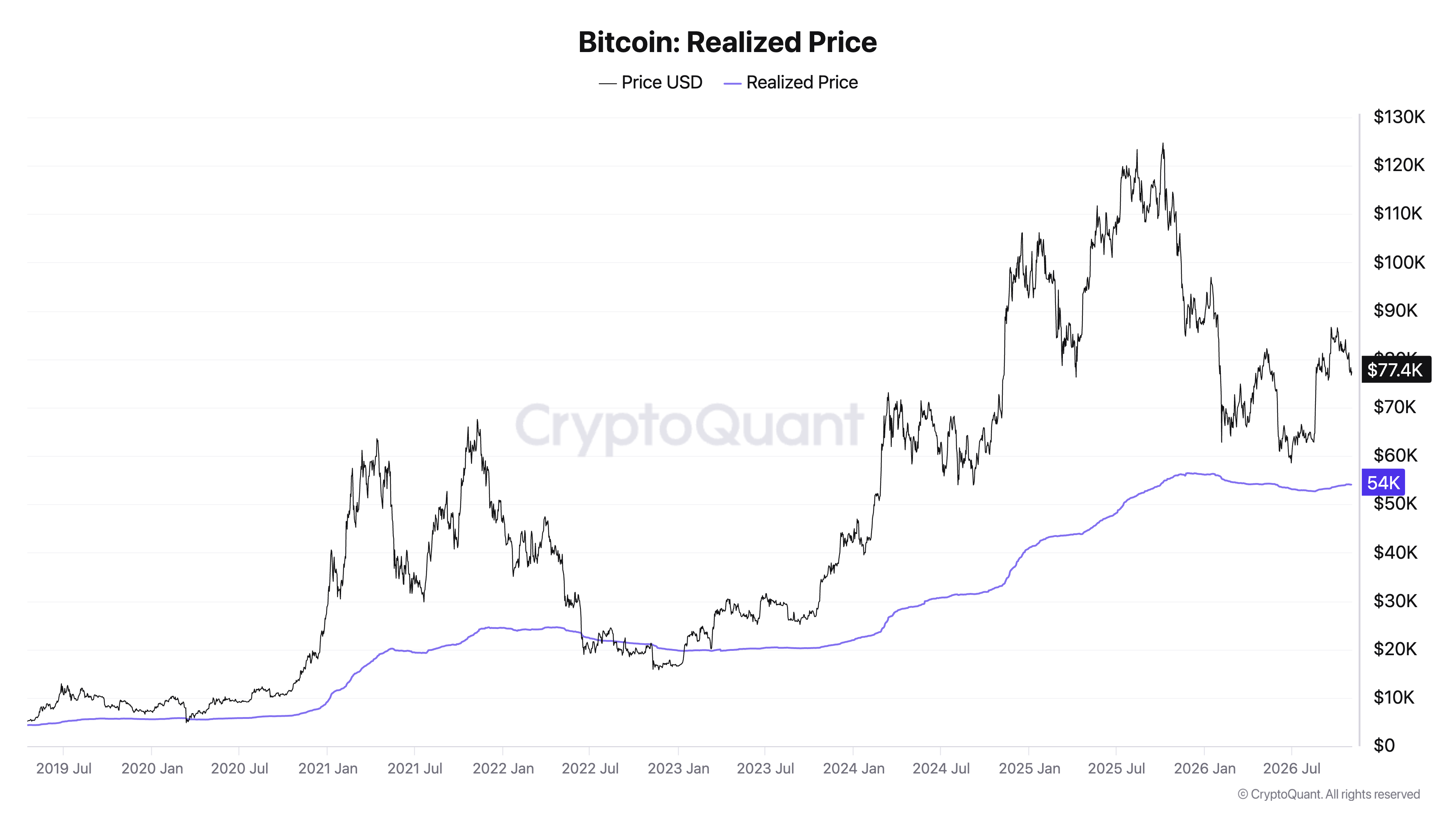
Source: CryptoQuant realized price chart.
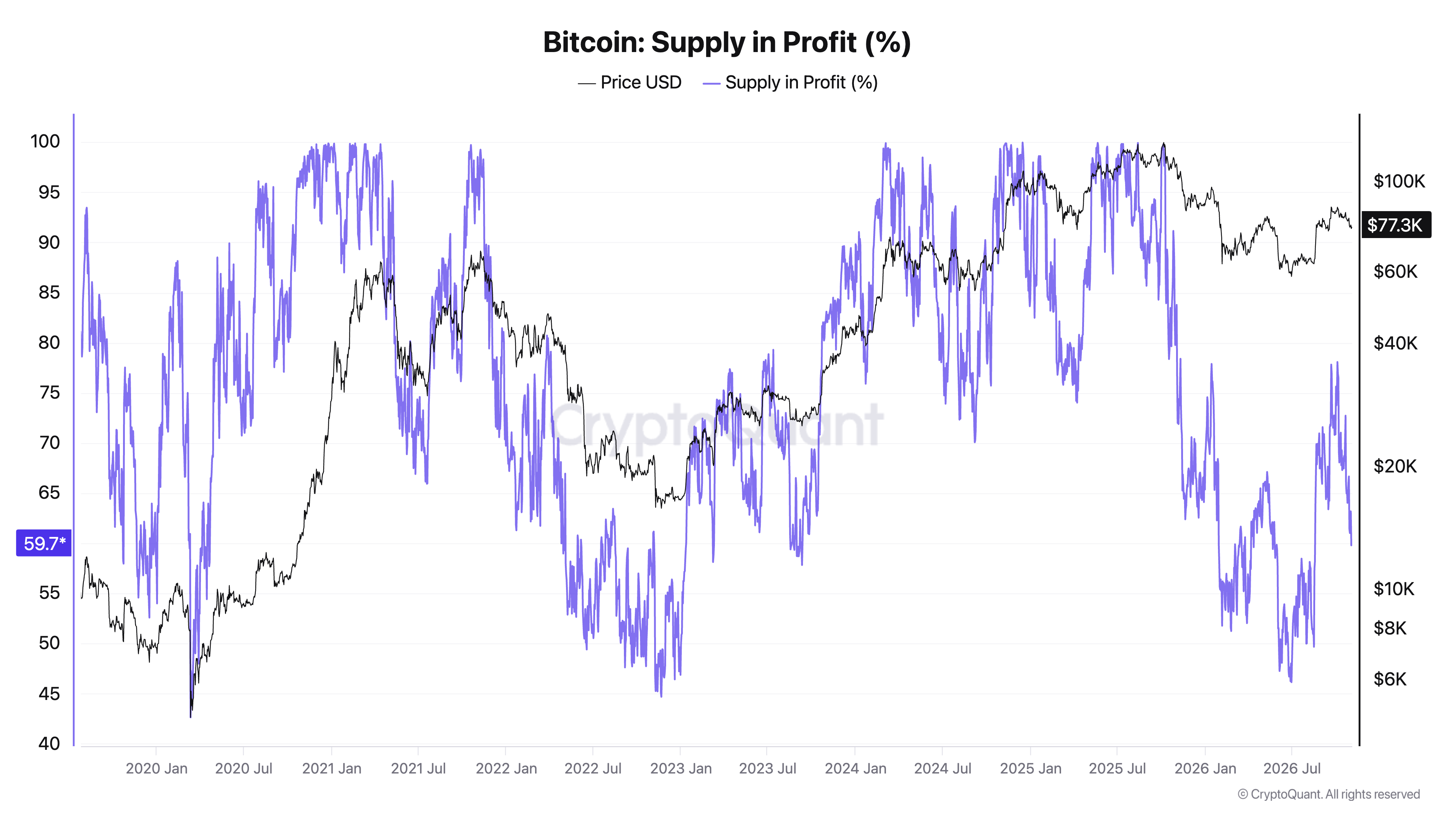
Source: CryptoQuant supply in profit
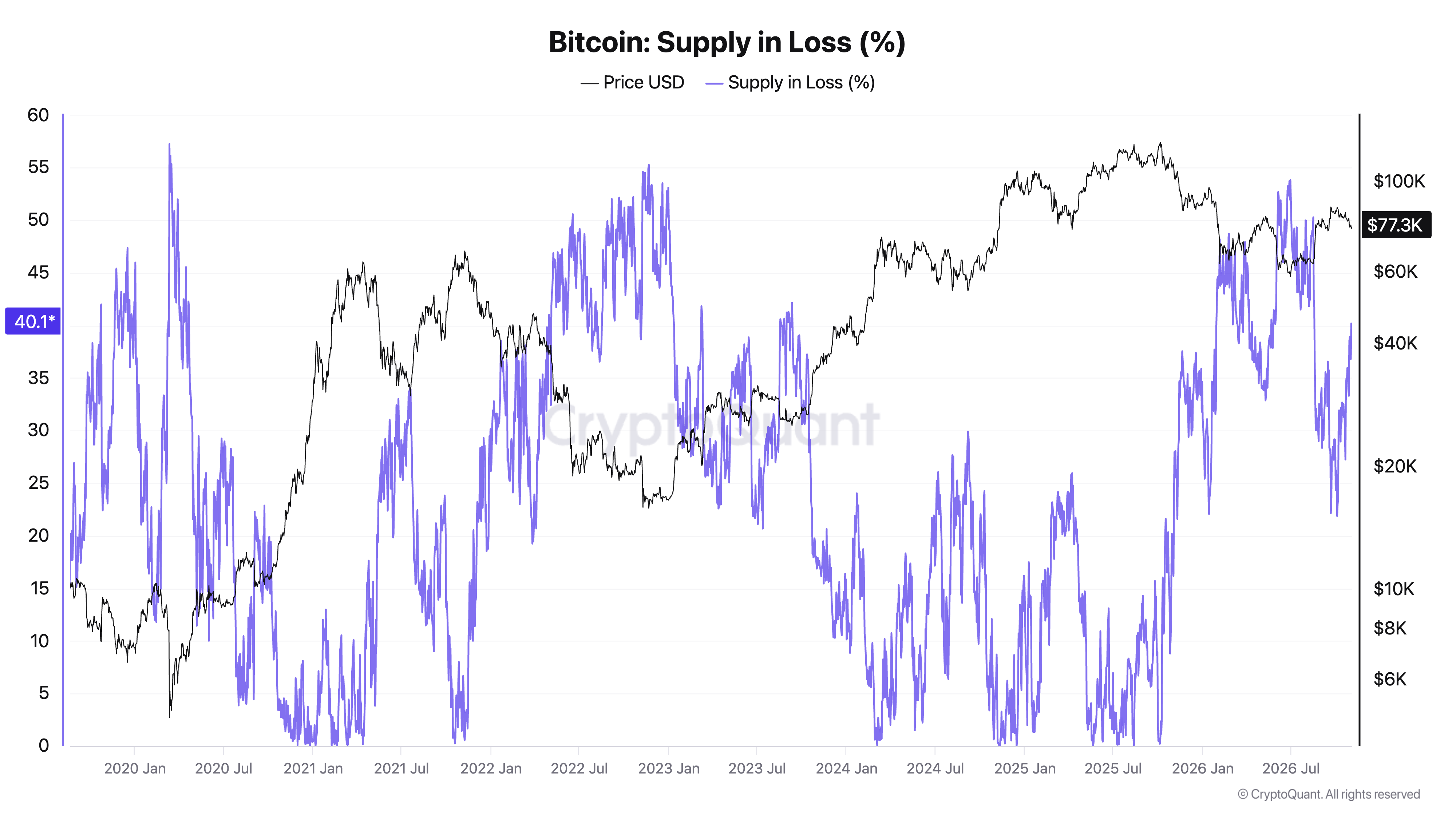
Source: CryptoQuant supply in profit/loss
Puell keeps a retest of realized price as a downside risk until the trend proves itself. He wants to see higher highs and higher lows on the chart, transaction volume that holds up, and SOPR staying above 1, meaning holders keep realizing profits without price making a new low. "We will need a few more months to be very sure that the trend is strong and continuing."
Julio pointed to heavy profit-taking after the move and price sitting near the one-year moving average, which has historically acted as resistance before a bull market. Puell agreed that a correction is likely, but said it could be a correction into a higher low, which would confirm the trend rather than break it. He also flagged that September has historically been a down month for risk assets in midterm years.
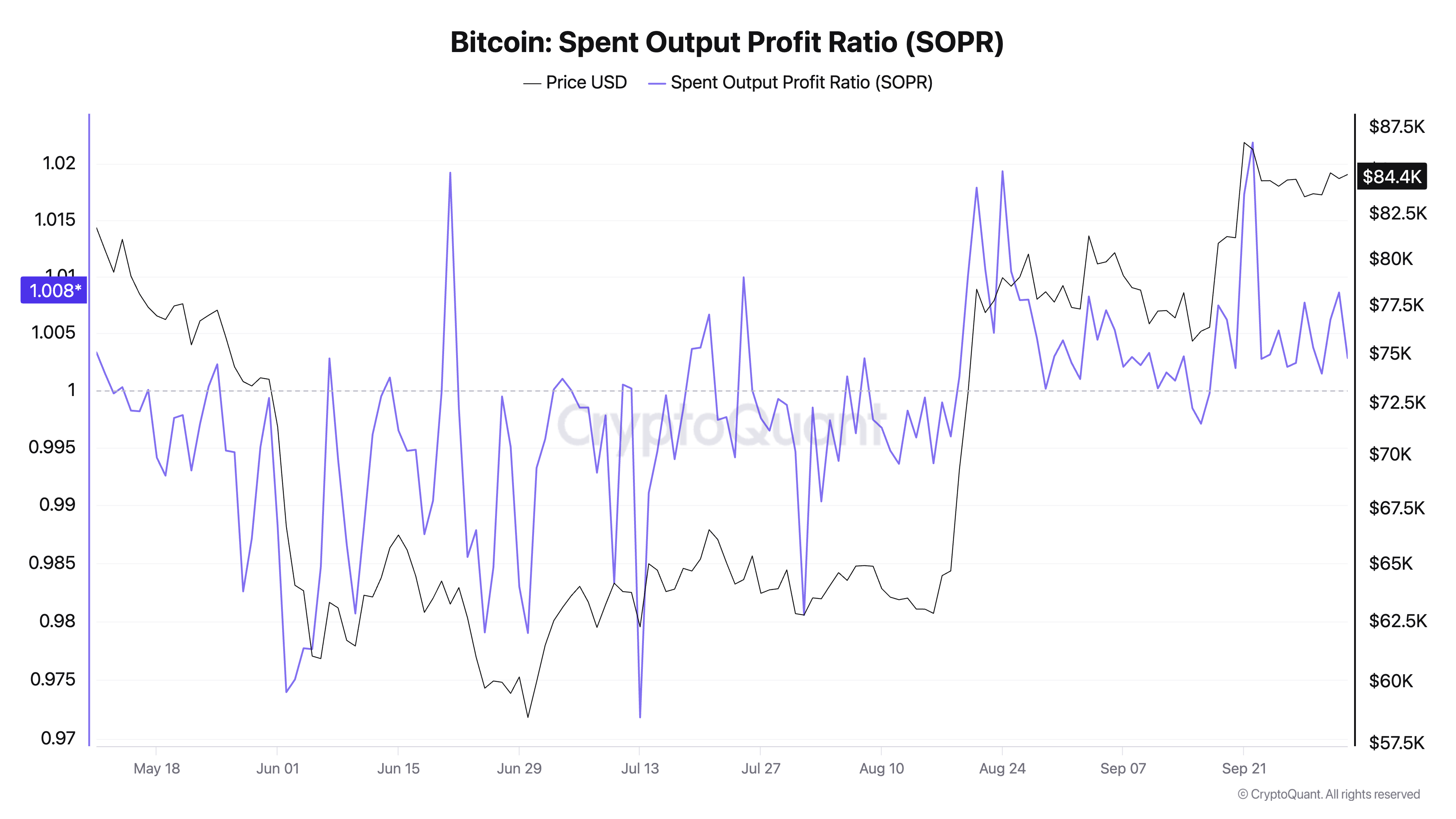
Source: CryptoQuant SOPR chart.
How to use on-chain metrics when they stop behaving
The historical levels of metrics like MVRV don't repeat exactly from cycle to cycle. Puell runs three checks before trusting a signal.
1.
Observer effects. Retail and institutions now watch the same metrics and front-run them. Institutions don't wait for a precise level below realized price. They average in early, and that alone can create a bottom. "History may rhyme, but certainly not to the T."
2.
Proportional moves. This cycle didn't go parabolic on the way up, so it's reasonable to expect a less severe move on the way down. That fits the long-run compression of Bitcoin's volatility and kurtosis, meaning fewer violent moves in short windows.
3.
Whether the metric still means what it used to. Structural changes add noise. Moves of ETF and treasury-company (DAT) holdings between custodians can show up on-chain as database changes rather than investor behaviour. Julio's example was Coinbase's cold-wallet migration, which moved roughly 800,000 BTC and sharply reduced long-term holder supply. That has to be adjusted for, or the signal degrades.
ETFs changed who the whales are
Puell was surprised by how well some metrics have held up through the ETF era, long-term holder supply included. ETFs act in aggregate, so real outflows still show up reflexively in long-term holder supply and coin days destroyed. The bigger change, in his view, is market structure: traditional investors average in and take profits before momentum turns parabolic, which keeps compressing volatility and makes alpha harder to find.
Julio raised the whale problem. The classic definition of a whale is 1,000–10,000 BTC per address, but ETF addresses tend to hold a few hundred BTC each, so large-holder cohorts now miss the biggest buyers. Puell has never relied on address-size metrics. It's hard to tell an exchange from an early miner, and a whale who got in early isn't necessarily smart money. He gets more signal from holding time, weighted by the volume of coins involved. Julio filters out exchanges and new whales, and tracks the growth of holdings rather than balance levels.
Seasonality: useful, but data first
The last cycle peaked in October, and some expect a bottom roughly a year after the top. Puell takes seasonality seriously. Whether it comes from the halving, interest-rate cycles or presidential cycles, the timing has held to within a month or two, even when everyone expected it to break. But it depends on where you measure from (the halving, the cycle high or the cycle low), and he weights it alongside the on-chain markers, not above them. Julio goes further: he runs his analysis on the data alone and lets seasonality line up with it or not. Both agreed that data matters more than the calendar.
Quantum: real threat, mostly priced in
Puell calls quantum the most important topic for Bitcoin over the next five to ten years, or at least until post-quantum signatures are live and widely adopted. He thinks it has put a discount on price for about a year, with some investors staying away because an existential risk outweighs the reward. But he believes the major developments so far are mostly priced in: Google's Willow chip, improvements to Shor's algorithm, and ECDSA.fail. Future breakthroughs in quantum hardware or software could still spook the market.
The episode was recorded on the day of three developments that Puell counts as steps forward:
The first quantum-resistant Bitcoin transaction. It's a fail-safe rather than a fix: by paying a miner directly, a user can protect a transaction in transit to a fresh, non-reused address.
A formal BIP proposal on GitHub for a post-quantum signature scheme. It starts the debate over hash-based, lattice-based or combined signatures.
Blockstream evaluating lattice-based cryptography.
He separates two kinds of risk:
Existential: short-range attacks on transactions in the mempool. That's likely further out, given how quantum architectures are scaling.
Contentious: dormant, likely lost coins, including Satoshi's. Estimates put these at 1.1 to 2.6 million BTC.
Puell expects what to do with dormant coins to be the most contentious debate in Bitcoin, more so than the choice of signature scheme. At ARK, he says, views differ. His own preference is an hourglass-style approach with incremental time locks, rather than freezing coins outright, possibly redirecting that supply to the security budget. He also finds Nic Carter's off-chain "salvage" idea interesting: coins are held in escrow, the rightful owner can reclaim them by proof, and protocol-level property rights are left untouched. He doesn't expect Satoshi to come back for them.
The hardest number to measure: demand
Julio asked whether demand can be measured directly. Puell's answer: only retrospectively. The one hard proof is holding period, meaning coins bought near a low that don't move through corrections, new all-time highs or a return to break-even. Everything else is educated inference. Mean reversion, losses outweighing profits and capitulation all tend to coincide with buyers absorbing seller exhaustion, provided the market is liquid enough.
Julio brought a method from his years as a commodity researcher: apparent demand. In commodities, demand can't be observed directly, but production and inventory changes can. For Bitcoin, production is miner issuance, and Julio defines Bitcoin inventories. Demand is then inferred from production and changes in those inventories. It has tracked Bitcoin's returns closely: growing in bull markets, and contracting even while Bitcoin traded above $100K. That contraction was part of how he saw the 2026 bear market coming while the macro picture still looked constructive.
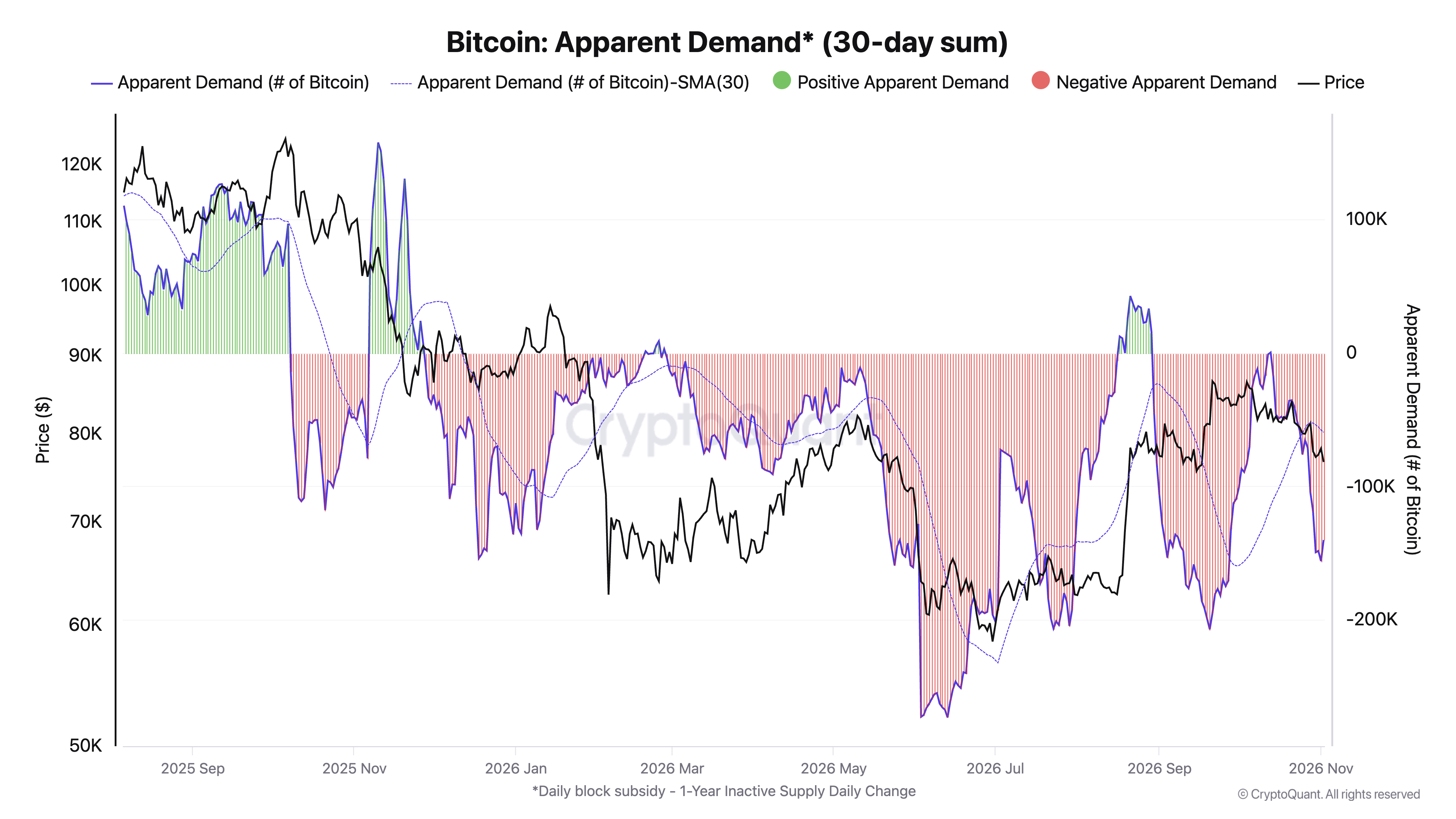
Source: CryptoQuant Bitcoin apparent demand chart.
Macro, on-chain and price targets
At ARK, macro is discussed weekly, and Bitcoin trades as a risk-on asset over a long enough horizon. Puell sees his role as covering the layer between macro and price. "Whatever decisions are being driven from investors based on the macro will show up in the on-chain space before it hits price." Bitcoin's correlations also shift, from the S&P 500 to gold and back.
On price targets, ARK publishes long-range estimates on its website. They are built bottom-up from the markets Bitcoin could take share of: gold investors, nation states, treasury companies, native on-chain activity and others, each with an assumed penetration rate. Julio avoids point targets. He uses realized price and short-term holder realized price bands to frame what a realistic expectation looks like once a bull market is confirmed.
Advice for new investors
Take your time. Learn which on-chain metrics actually suit your trading style, time horizon and risk profile. Do your own research, form your own conviction, and be careful with scammers and influencers.
Watch the full episode
Watch David Puell on Unbiased. Then explore the metrics from the episode on CryptoQuant: realized price, SOPR, supply in profit and loss, long-term holder supply, and apparent demand.
Track these metrics live on CryptoQuant. Start free.
FAQ
Who is David Puell?
David Puell is an on-chain analyst at ARK Invest, which he has been with for about four years. He has been in the crypto industry for about nine. He created the Puell Multiple, a widely used miner-revenue indicator.
Has Bitcoin bottomed, according to David Puell?
Possibly, but it would be an atypical bottom. Capitulation markers fired, with supply in loss overtaking supply in profit. But the drawdown was only about 50%, and price never reverted to realized price. Puell treats a retest of realized price as a downside risk until higher highs, higher lows and SOPR above 1 confirm the trend.
Do on-chain metrics still work after the Bitcoin ETFs?
Mostly, yes. Metrics like long-term holder supply still respond to ETF flows in aggregate. But analysts need to adjust for custody moves, address-size cohorts that no longer capture ETF holdings, and investors front-running well-known levels.
Is quantum computing priced into Bitcoin?
Puell believes current quantum developments are largely priced in, after a discount that has weighed on price for about a year. Future breakthroughs could still move the market.
What is Bitcoin apparent demand?
It's a CryptoQuant metric developed by Julio Moreno that estimates demand indirectly. Using a method from commodity research, it infers demand from production (miner issuance) and changes in Bitcoin inventories.